
Lore
In The Lamplighters League, part of the narrative team’s job was to write and implement lore drops that rewarded player exploration by adding texture and depth to the world, hinting at character backstories, and providing in-world explanations for mechanics and enemies.
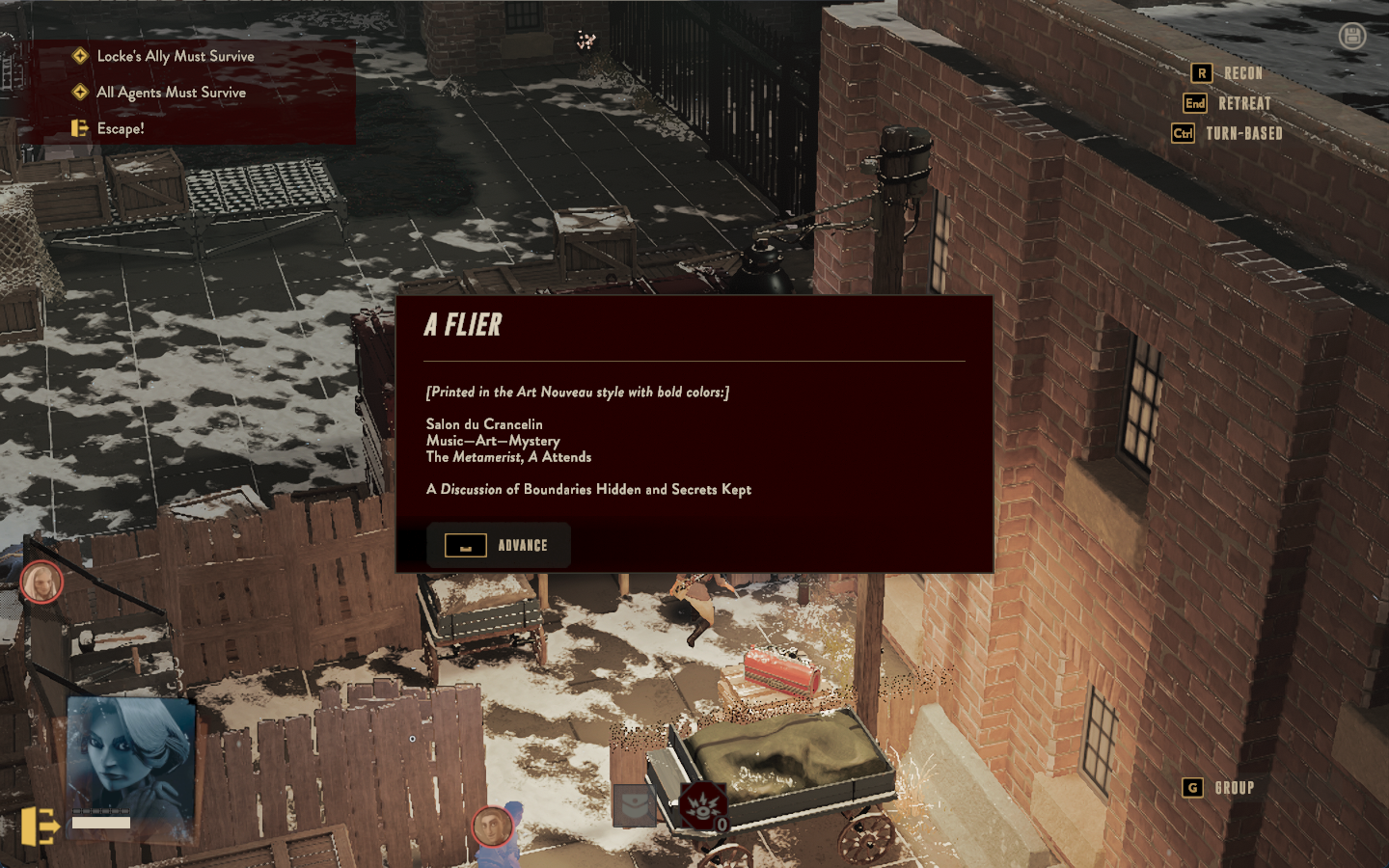
Our lore system allowed us to place “sockets” throughout each level and then populate each socket with lore based on the environment type, the week of the campaign, and what lore pieces the player had previously seen. In bespoke levels we created lore that helped the player solve puzzles, but the vast majority of lore was more ephemeral. Below are a sample of both lore drops — written as if the text is on something the player has physically picked up — and “inspections” — written like third-person narration or a GM’s description of scene details.
A Letter
[A letter typewritten on fine paper.]
S,
We need to have a serious talk about resource allocation if Lady N is going to keep burning through troops for her hocus-pocus horseplay. Look at us: you’re out a unit doing clean-up in Marseilles, I’m out a squad doing maintenance on the Crossroads, and she didn’t even deliver the cards.
You and I both know this isn’t how you run an efficient company.
What’s done is done, but the next time she wants to go running off after a holy grail or a magic ring, she can do it with her own men. Our men have a Tower to get to.
—JTM
An Academic Squabble
[From “Archaeology, Mar. 1930”]
Skeptics will point to the lack of physical evidence of this pre-civilization people. We have mummies from Ancient Egypt, grave goods from the tribes of America, bronzes and sculpture from the cities of Africa. But the answer is contained in the question: historical texts all show that a great catastrophe impacted the world some thousands of years ago, and wiped out the people that came before.
—Bailey, “In Situ Evidence of Pre-Historic Giants”
An Academic Squabble
[From “Studies in Anthropology and Folklore, Jun. 1930”]
Though Bailey’s proposal of a pre-historical civilization peopled by giants lacks physical evidence, she does identify an intriguing throughline among ancient traditions. The idea of a “catastrophe,” often in the form of something collapsing or falling from the sky, reappears frequently.
The consistency of the portrayal in vastly different parts of the world, with different geographies and environments, suggests to me that these stories can all be traced back to a single story: that the Tower of Babel may, in fact, have some truth to it, as the first catastrophe from which all human stories sprung.
—Rosen, “The Fall of the Tower as Ur-Story”
A Journal
[A page from a Captain’s journal. The writing is rushed and sloppy.]
When I looked up from the Scroll it was like coming up for air. The lights were too bright in my eyes, my arms felt like lead. It hurt to stop reading, but da Silva was shaking me and insisting I come inspect the troops.
I have to go back. I saw shapes down there in the Deep. How am I supposed to sleep until I see them clearly?
The Marteau Method
[The photograph on this page features a triumphant Trace Marteau striding across the back of a prone factory worker. The pained expression on the man’s face looks genuine.]
Two men can’t walk through one door at the same time. Someone’s got to go first, and if it isn’t you, it isn’t you.
—The Marteau Method of Self-Mastery, Rule XIX
Flaking paint outlines the name of this steamer: the Laudanum Prophet. Waves slap against the hull in a rhythm as soporific as the ship’s namesake, whispering of euphorias too tenebrous for the day.
A crate holding a Purifier’s flamethrower, empty of fuel. The straps that attach it to the soldier’s back are heavy and secure, impossible to undo with gloved fingers.
 Anthea Carns